invites you to
join the
Delta Boogie
email list
|
|
Hairy Larry invites you to join the Delta Boogie email list |
|
1946: Earl Scruggs Brings His Banjo to Missouri
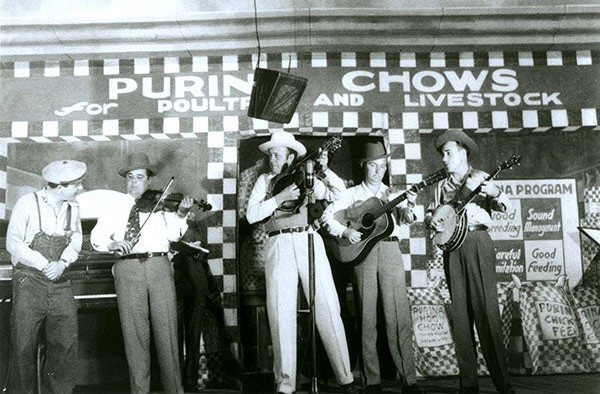
Bill Monroe & His Bluegrass Boys on tour, circa 1946, from left: Monroe, Chubby Wise, Lester Flatt, Earl Scruggs, and Howart "Cedric Rainwater" Watts. Digital image from the Country Music Hall of Fame, from non-commercial use.
Draft book passage by Matt Chaney, Copyright 2025 for historical arrangement
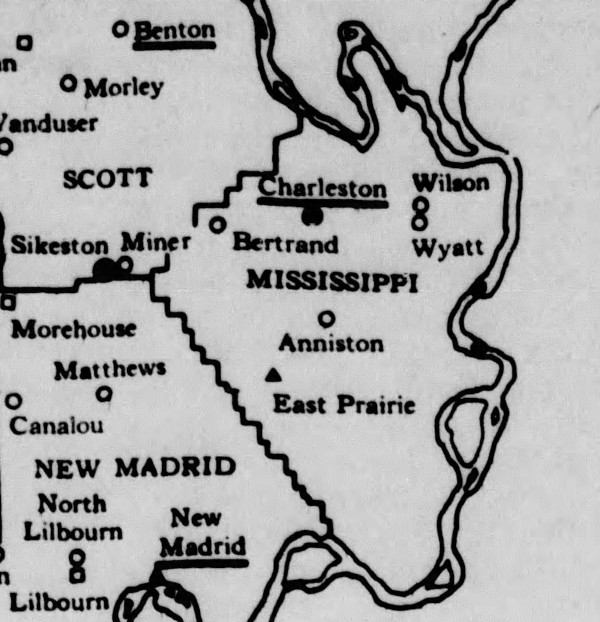
As World War Two ended, East Prairie, Mo., stood as an agricultural hub in the Bootheel flatlands, along roads and rails connecting the Mississippi River nearby.Great American music was a pastime in East Prairie, population 3,000, and Mississippi County at-large, where the arts were indulged and cultivated since steamboats. Cairo, Ill., was a short drive away, historic riverport and entertainment hotbed. Cities were close enough by car, with Mississippi County located midway between St. Louis and Memphis.Local music talent flourished while touring professionals had frequented East Prairie and sister town Charleston for generations. Legends locally had included W.C. Handy for the blues, Fletcher Henderson in jazz swing, “Blue Yodeler” Jimmy Rodgers, and “radio stars” from the Grand Ole Opry in Nashville, led by banjoist Uncle Dave Macon and bluegrass picker Bill Monroe.Monroe sent East Prairie buzzing in early 1946, bringing Earl Scruggs to town, breakout banjoist for WSM Radio’s Grand Ole Opry and on tours with Monroe’s Bluegrass Boys. The East Prairie Women’s Improvement Club sponsored the show, set for March 14 at the high school. Advertisements touted “Earl Scruggs with his Blue Ribbon Banjo,” a familiar _expression_ for listeners of WSM.
Mississippi County, Mo., delta flatlands, with the principal towns of Charleston and East Prairie.
Arriving in Nashville a few months previously, Scruggs, 22, had been relatively unknown, performing rigid and expressionless on stage, quite the contrast to conventional banjo players. Loud Opry star Uncle Dave Macon played “clawhammer” style, for example, and used his banjo as a comedy prop.But quiet Earl Scruggs hit Nashville like an earthquake, having perfected the three-finger roll on “banjer,” a style peculiar to his native Carolinas.“He learned to emphasize melody by plucking with his strong thumb in syncopation with harmonic notes picked with his last two fingers," observed Christopher Lehmann-Haupt, modern music critic. "The sound was like thumbtacks plinking rhythmically on a tin roof."
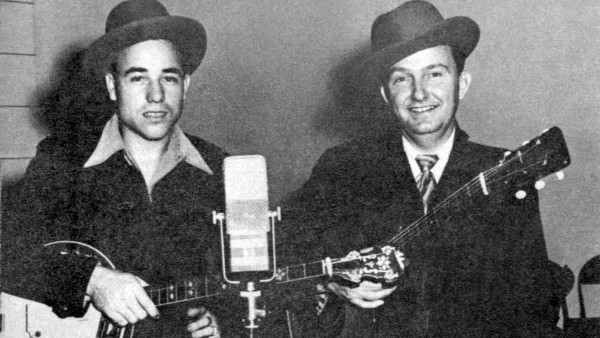
Banjo extraordinaire Earl Scruggs, left, and guitarist Lester Flatt, circa 1949, after the duo founded their bluegrass band, the Foggy Mountain Boys. Digital image from wikimedia.
Scruggs inspired a “revolution” in banjo play, remarked critic Geoffrey Himes. “He wasn’t the only banjoist experimenting with a new technique that was much more versatile than the old flailing, drop-thumb style, but no one did the three-finger roll as briskly or as crisply. And the syncopated pulse of the roll was perfect for the fast, bluesy style that Monroe had originated.”“Mr. Scruggs’ style of playing cemented—some would say created—the bluegrass sound,” Peter Cooper noted for the Nashville Tennessean in 2012. “And while Monroe is correctly credited as the genre’s father, the music would not exist in its current form without Mr. Scruggs.”“To this day, many bluegrass players spend their lifetimes trying to achieve a reasonable approximation of what Monroe, Mr. Scruggs, [Lester] Flatt, fiddler Chubby Wise and bass player Howart Watts achieved onstage in 1945, and in the studio in 1946 and 1947.”***
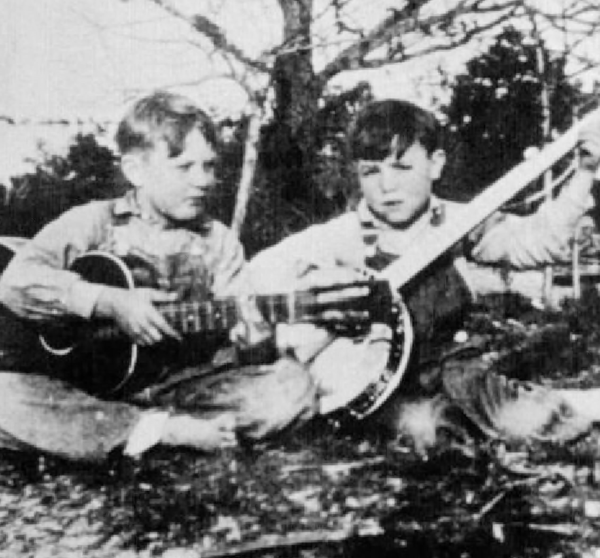
Horace Scruggs, left, and his younger brother Earl Scruggs in Cleveland County, N.C., circa 1935. At about age 11, Earl Scruggs learned the "three-finger" roll on banjo, enroute to perfecting the syncopation technique like no player before him. Photograph from The Associated Press.
Earl Eugene Scruggs was born Jan. 6, 1924, in Cleveland County, N.C., at the border with South Carolina. Earl was the third son and baby among five children for George and Lula Scruggs, a family of musicians. George, a farmer and bookkeeper, woke his sons with a banjo every morning, although Earl would retain no memory; his father died when the boy was four.But a template seemed set in Earl’s imagination, his youthful drive for playing banjo, an instinct for picking borne, perhaps, by his late father. He heard big brother Junie Scruggs play the three-finger roll on banjo, along with other locals. Kid Earl flailed at the banjo, thumbing the fifth string for melody, “claw-hammering” others, until he tried three-finger picking. The method clicked for him around age 11.Earl Scruggs later recalled: “I was sitting in a room pickin’ this tune called ‘Reuben’ … just pickin’ and thinkin’ about something else. Suddenly I was pickin’ and usin’ the other finger, and the two-finger style left me. It just came suddenly like that.”“That really turned me on because I could play along with the slow tunes as well as the uptempo tunes … The banjo stayed on my mind just about all the time.”Earl’s opportunity to play was limited, however. He had scant spare hours even on weekends, attending school while increasing his workload on the farm, to running the place a decade after his father’s death. The older brothers had moved on.“There I was, 14 years old and living the life of a married man with two women to support,” Scruggs recalled, referring to his mother and a sister. “All my thoughts at that time were on the banjo, almost day and night. Constantly.”“Back then, we couldn’t hardly get our school in for the farming. So, about the only times I got to pick was a little bit before breakfast and sometimes, if I felt like it, a little bit during the noon hour while I was resting.”“But I would plow from one end of the field to the other with tunes runnin’ through my head. When I’d get back to the house, as soon as I could get hold of the banjo, I’d see if it would work out. That’s the way I worked a lot of tunes.”
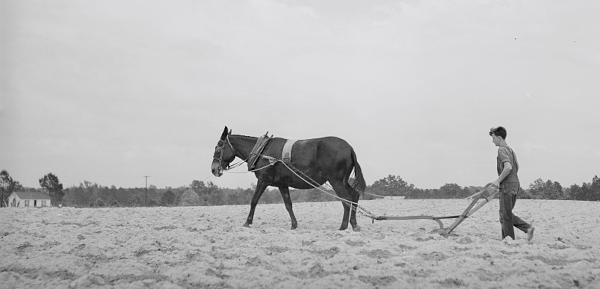
A youth plows a farm field in North Carolina, 1940, near Durham. In Cleveland County, teenager Earl Scruggs ran the family farm while constantly thinking of playing banjo, he later recalled. Photograph by Jack Delano, U.S. Farm Security Administration, with digital image from the Library of Congress.
Lula Scruggs ultimately left the farm, and around 1941 Earl was hired to play banjo at Spartanburg, S.C., earning $12 weekly with the Morris Brothers Band on radio station WSPA. He took a job at Lily Thread Mill for 40 cents an hour, working overtime. “I thought I was getting rich,” he said. “I did very well, was able to buy my first automobile after a while.”And Earl Scruggs kept improving on banjo."Until Earl came along, no one really took the banjo as a serious instrument," said Ricky Skaggs, string musician, in 2002. "When Earl, with his mathematical mind and his skills, got ahold of the three-finger roll idea that a few older guys from North Carolina had spurred, well, he took that and just absolutely mastered it.""It revolutionized the banjo."***
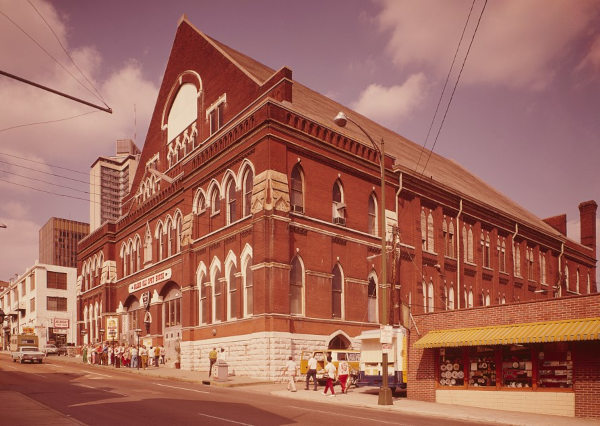
Ryman Auditorium in Nashville, Tenn., circa early 1970s, home of the Grand Ole Opry on WSM Radio. The Opry's last show in Ryman was March 15, 1974. Photograph by Cary Brian for the Historic American Buildings Survey, with digital image from the Library of Congress.
Around Thanksgiving in 1945, John Miller, a bandleader from WNOX in Knoxville, Tenn., brought Earl Scruggs to Nashville, the big leagues of country music.“Lost John" Miller and His Allied Kentuckians featured the extraordinaire Scruggs on banjo, making their jump to WSM Radio, snagging a 15-minute show slot at 7:45 on Saturday mornings.On Saturday nights, 50,000-watt WSM broadcast the Grand Ole Opry on clear channel radio, live from Ryman Auditorium in Nashville. Networks carried the show.Among Lost John’s morning band, only Earl Scruggs would see the Ryman stage to play national radio, and soon.Bill Monroe heard Scruggs pick and wanted him for the Bluegrass Boys, immediately. Scruggs first resisted the offer to audition, until John Miller encouraged him to do it.
Bill Monroe & His Bluegrass Boys on stage at Ryman Auditorium, circa 1946, for the Grand Ole Opry on WSM Radio in Nashville. From left: Howart "Cedric Rainwater" Watts, comic bass player; Chubby Wise, fiddle; Bill Monroe, mandolin; Lester Flatt, guitar; and Earl Scruggs, banjo. Digital image from Ryman Auditorium, for non-commercial use.
Scruggs auditioned in the Tulane Hotel for Monroe’s band, and guitarist Lester Flatt was skeptical about hiring another banjo player. Clawhammer pickers, such as previous banjoist David “Stringbean” Akeman, did not meld with the jamming Bluegrass Boys.But then Scruggs demonstrated his three-finger roll, astonishing Flatt. “I had never heard anybody pick a banjo like he did,” Flatt said later. “He could go all over the neck and do things you just couldn’t hardly believe. [Monroe] said, ‘What do you think?’ And I said if you can hire him, get him whatever it costs.”Scruggs joined the band, debuting on the Grand Ole Opry from Ryman Auditorium on Dec. 8, 1945, according to accounts. Nashville’s banjoists were stunned, even disheartened, hearing Scruggs; he seemed from the Atomic Age, stirring nuclear fission on the strings. The sound was incredible.“Earl Scruggs was just a-playing that old banjo,” said Louis “Grandpa” Jones, comic banjo man for The Opry. “You know how he could play, my goodness.” Clawhammer banjoist Sam McGee heard Scruggs finish and remarked, “Well, I’m going to take my banjo home and build a hen’s nest in it.” Uncle Dave Macon, for his part, critiqued the unsmiling newcomer thusly: “Well, he’s a good player, but he ain’t a damn bit funny.”
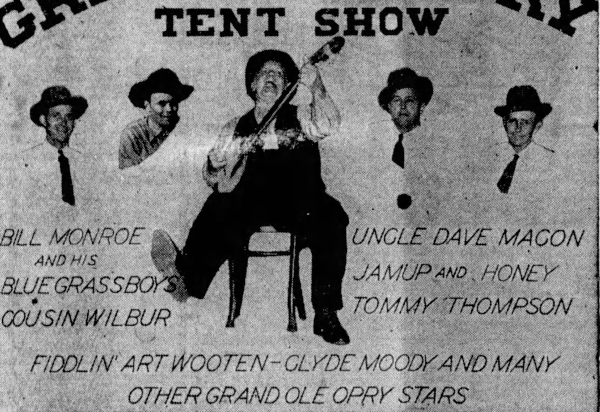
Uncle Dave Macon, foreground, 1942, comic banjoist of the Grand Ole Opry in Nashville. The superstar Macon played banjo "clawhammer" style, in contrast to the "three-finger roll" perfected by Earl Scruggs, who debuted on The Opry in 1945, for Bill Monroe's Bluegrass Boys. Advertisement for a show in Poplar Bluff, Mo., printed by the Daily American Republic newspaper.
Dave Macon et al were merely witnessing the present state of their art, with their dated play to become known as “old-fashioned banjo.”"Scruggs' three-finger style was not wholly of his own devising, having been developed by a group of now-forgotten musicians,” stated critic Paul Wadley.“What Scruggs brought to the technique was a drive, dexterity and attack that emphasized the melody line and left the traditional frailing approach of strummed chords languishing largely in the dust."***
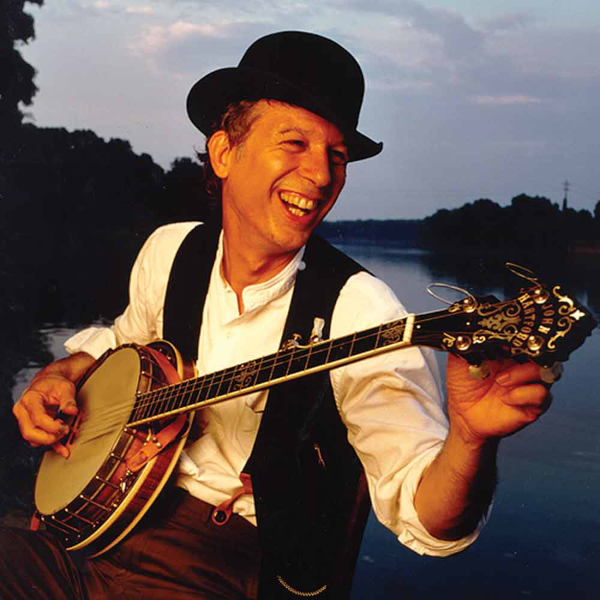
Banjoist John Hartford, circa 1970s, St. Louis native who credited Earl Scruggs as his prime inspiration on the instrument. Digital image from wikimedia.
John Hartford, banjo master reared in St. Louis, discussed his favorite music model with reporters in 1971.“Earl Scruggs is probably the biggest single influence on my career as a musician,” declared Hartford, age 33. “Scruggs inspires. I have been an admirer of him and his talent since I first heard him when I was a kid.”“I’m from St. Louis. I came out of bluegrass. I still love it,” added Hartford, who graduated from John Burroughs School under his given surname, Harford, without the “t” [added by record makers in the latter Sixties].Hartford produced a cherished tape recording which he played for a writer—a 1948 broadcast of Grand Ole Opry with Bill Monroe’s Bluegrass Boys and specifically Earl Scruggs, tearing it up on banjo. The Ryman audience roared in approval, cheering and clapping.“You hear that now? They’re breakin’ up,” Hartford said, delighted. “That’s why I love Scruggs so much. He wasn’t the first banjo player I ever heard, but he was the first … who didn’t try to make a comedy routine of it.”“People had never heard anything like it before. He was like a rock act.”A quarter century before in East Prairie, Mo., March 1946, music fans knew of Earl Scruggs, those tuned to WSM, when he appeared at the high school with Bill Monroe. Many onlookers were surely taken aback, smitten with Scruggs’ atomic banjo.
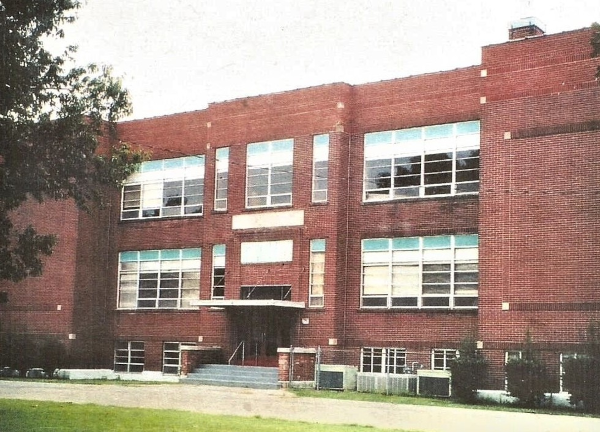
The old high school in East Prairie, Mo., circa 2000s. On March 14, 1946, Bill Monroe and His Bluegrass Boys, featuring Earl Scruggs on banjo, played in the high school gym. Digital image from Larry Myres, of the FB group "Remember East Prairie When."
Little in way of a show review has been located for Earl Scruggs in the upper delta that March, among e-searches of historic news pages. The available advertisements place Monroe’s Bluegrass Boys at East Prairie and Dexter in southeast Missouri, along with Blytheville and Jonesboro in northeast Arkansas. Undoubtedly, there were more show dates in the region.Remarks retrieved from East Prairie indicated a big crowd saw Scruggs excel for Bill Monroe & His Bluegrass Boys. “Thanks To Donors,” announced a headline in the East Prairie Eagle, following the show.“The Women’s Improvement Club wish to extend their thanks to the High School for the use of the Gymnasium last Thursday evening. Our Grand Ole Opry show was a big success.”
—30—
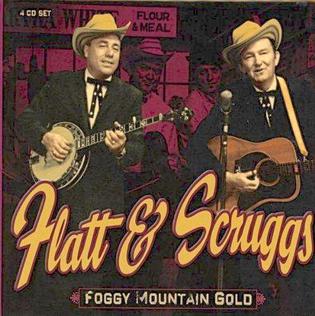
2014 CD compilation of songs by Lester Flatt and Earl Scruggs, who headed their band Foggy Mountain Boys from 1948-69. Digital image from wikimedia.


Hairy Larry blogs music and more at Delta Boogie Network
Email Hairy Larry
Copyright by Larry Heyl and Vivian Heyl